
There is a particular kind of campervan build that looks fantastic on Instagram and quietly punishes you everywhere else.
Heavy oak worktops. Thick cladding. Oversized cabinets. Steel mechanisms. Domestic-style furniture built as if the van were a little cottage rather than a machine that has to accelerate, brake, corner, climb hills and stay within its legal weight.
This is especially common when the build is being done by a keen hobbyist carpenter. And that is not an insult. In fact, it is often the opposite. A skilled DIYer knows how to make furniture solid, durable and reassuringly overbuilt. Thick panels, extra framing, chunky supports and redundant structure all feel sensible in the workshop. In a van, they often become dead weight.
That matters more than many people realise.
A heavier build puts more strain on the vehicle, eats into payload, affects handling, increases stopping distances and leaves less capacity for the things you actually travel with: water, food, bikes, boards, clothes, children, dogs, all the mess and freedom of real trips.
The goal is not to build the heaviest possible interior that feels indestructible when parked up. The goal is to build the lightest interior that performs properly on the road.
This is the real principle behind lightweight campervan furniture.
Strength does not have to come from brute weight. It can come from geometry, load paths, joinery and intelligent use of materials. Good design removes unnecessary mass while keeping the parts that actually do the work.
That matters because in campervan design, people often assume that heavier means better built. It often just means more material has been thrown at the problem.
A good example is a bed. It is one of the most demanding pieces of furniture in the van. It has to support real body weight, work smoothly, convert easily, and often do several jobs at once. Our own sliding bed is a good example of what smart lightweight design can do. It weighs around 25 kg, yet it can support 200 kg in use. That is not magic. It is simply what happens when the structure is designed properly, rather than overbuilt by instinct.
Less mass. Proper strength. Better use of space. That is the target.
It is worth being fair here.
There are situations where heavier systems make complete sense. A classic example is the rock and roll bed. If you genuinely need extra belted travel seats for more than three people, a heavy rock and roll bed can be a completely logical choice. You are not just buying a bed in that case. You are buying a seating and travel solution, and the weight comes with that function.
But if you do not need that function, it is worth asking a hard question: are you carrying a huge amount of steel, mechanism and fixed bulk for a problem you do not actually have?
This is where lightweight design starts to make sense. Not because heavy systems are stupid, but because many van builds end up carrying far more permanent weight than they really need.
The benefits are not abstract.
A lighter van is easier to live with and easier to drive. It feels less burdened. It preserves more of the original vehicle's agility. It gives you more payload for the things that matter on an actual trip. It reduces the temptation to creep over legal weight limits without noticing.
It also changes how usable the interior feels day to day.
A well-designed lightweight bed system can give you a bench, a lounge and a bed without dominating the whole van with steel and bulk. Lightweight slatted systems also improve airflow under the mattress, which matters more than people think in a small, damp environment. Better airflow means less trapped moisture and less risk of condensation building up underneath where you cannot see it.
So the benefit is not just that the van weighs less. It is that the van often works better.
Furniture is a big part of the equation, but it is not the only part.
A lightweight campervan is usually the result of dozens of smaller decisions, not one dramatic one.
Lithium batteries are a classic example. They can save a significant amount of weight compared with lead-acid while giving you more usable capacity. Water is another. Many people build around huge tanks or carry more than they realistically need, when a smaller jerrycan system would suit their style of travel perfectly. The same applies to thick hardwood worktops, excessive cladding, oversized storage units, permanently installed extras, elaborate internal partitions and anything else that feels more like domestic furniture than mobile design.
The pattern is always the same: lots of small "just in case" decisions adding up to a van that is heavier, clumsier and less efficient than it needed to be.
Materials are only part of the story, but they still matter.
Solid wood is beautiful, but usually too heavy for a practical camper build. MDF and chipboard are cheap, but they add unnecessary mass and cope badly with moisture. Aluminium has its place, but for furniture it can feel cold, industrial and more complicated than it needs to be. In most cases, plywood remains the best all-round material for campervan furniture because it offers a strong balance of strength, stability, workability and weight.
But not all plywood is the same.
Species, core quality and thickness make a big difference. Good lightweight plywood can outperform heavier alternatives when it is used intelligently. That is why the conversation cannot stop at "plywood versus not plywood." The real question is what kind of plywood, how much of it, and whether the design is actually making the most of it.
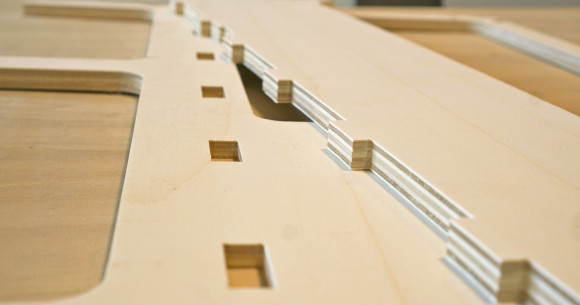
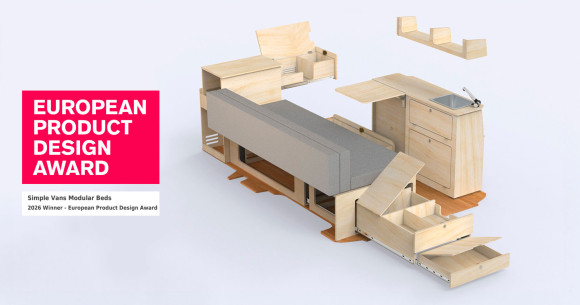
Poplar plywood is our go-to material for good reason. It gives us the sweet spot we are always chasing: light, strong and genuinely beautiful to live with. We then push that logic further by mixing 10 mm and 15 mm panels so material goes where it is actually needed, rather than making everything uniformly chunky for reassurance. The result is a better strength-to-weight ratio across the whole build. To put that in real terms, a standard Drifter kit weighs just 64 kg — that is your bed, sofa, bench, front kitchen unit and side cabinet as one complete furniture set. Lighter than a full suit of armour, and more useful — unless you're on your way to a joust.
A campervan is not a house. It is a vehicle first.
That does not mean it cannot be beautiful, comfortable or satisfying to build. It means every kilo should justify itself. Every panel, every mechanism, every extra layer and every clever addition should earn its place.
That is the real case for lightweight campervan furniture.
Not minimalism for its own sake. Not stripped-back austerity. Just smarter design. Less dead weight. More usable space. Better storage. Better versatility. Better driving. More room in your payload for the things that make a trip feel like a trip.
Build light, and you give yourself more freedom everywhere else.

Compatible with all large vans like the Fiat Ducato, Peugeot Boxer, Citroën Jumper, Renault Master, Opel Movano, Nissan NV400, Mercedes Sprinter, Volkswagen Crafter, Iveco Daily...
Compatible with all large vans like the Fiat Ducato, Peugeot Boxer, Citroën Jumper, Renault Master, Opel Movano, Nissan NV400, Mercedes Sprinter, Volkswagen Crafter, Iveco Daily...
By THEME
SIMPLE VANS
USEFUL INFORMATION & LINKS
Compatible with all large vans like the Fiat Ducato, Peugeot Boxer, Citroën Jumper, Renault Master, Opel Movano, Nissan NV400, Mercedes Sprinter, Volkswagen Crafter, Iveco Daily...
Compatible with all large vans like the Fiat Ducato, Peugeot Boxer, Citroën Jumper, Renault Master, Opel Movano, Nissan NV400, Mercedes Sprinter, Volkswagen Crafter, Iveco Daily...
By THEME
SIMPLE VANS
USEFUL INFORMATION & LINKS
Please sign in first.
Sign in